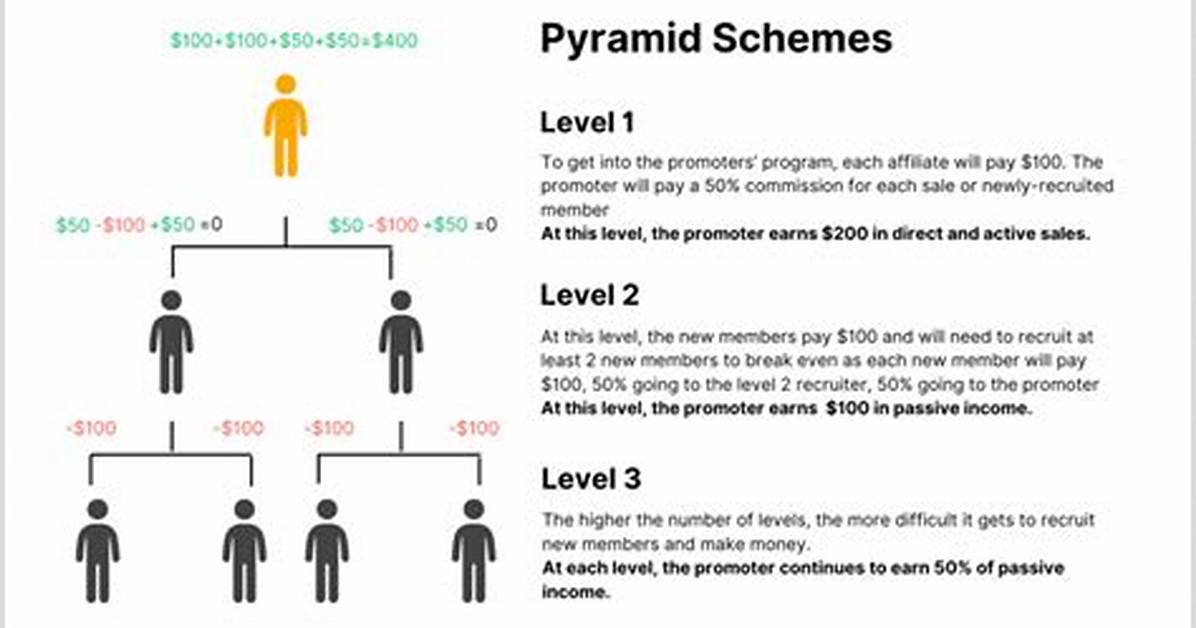
Pyramid schemes are fraudulent investment strategies that prioritize recruitment of new members over legitimate business activities or product sales. These schemes operate on a hierarchical structure where participants at the top recruit others to join the scheme, who in turn recruit more members.
Money flows up the pyramid to higher-ranking members, while those at the bottom struggle to recoup their initial investments. The scheme eventually collapses when recruitment slows down, leaving the majority of participants with significant financial losses.
Characteristics of Pyramid Schemes
- Focus on recruitment: Pyramid schemes primarily concentrate on recruiting new members rather than selling genuine products or services. The emphasis is on expanding the pyramid structure to generate profits.
- Promises of easy money: Pyramid schemes entice participants with the promise of quick and substantial financial gains. However, these claims are often unrealistic and rely solely on recruiting more members into the scheme.
- High signup fees: To join a pyramid scheme, participants are typically required to pay high signup fees, which serve as a major source of revenue for the scheme’s organizers.
- Lack of genuine products or services: Unlike legitimate businesses, pyramid schemes often lack tangible products or services that provide value to customers. The focus is on the recruitment process rather than offering legitimate offerings.
Notorious Pyramid Schemes
United Sciences of America (USA): This pyramid scheme operated in the 1990s, promising individuals substantial financial rewards for recruiting new members into the scheme. The scheme collapsed in 1997, resulting in significant financial losses for its participants.
WakeUpNow: Active from 2009 to 2015, WakeUpNow marketed itself as a multi-level marketing (MLM) company, but its practices resembled a pyramid scheme. The scheme faced legal action and eventually shut down.
Vemma: Vemma, a health and wellness company, was sued by the Federal Trade Commission (FTC) in 2015 for operating as a pyramid scheme. The company emphasized recruitment over legitimate product sales, leading to legal consequences.
To visualize the structure of a pyramid scheme, refer to the table below:
| Pyramid Level | Number of Members | Earnings |
|---|---|---|
| Level 1 (Top) | 1 | Initial signup fees from all members below |
| Level 2 | 2 | Signup fees from new members recruited |
| Level 3 | 4 | Signup fees from new members recruited |
| Level 4 | 8 | Signup fees from new members recruited |

