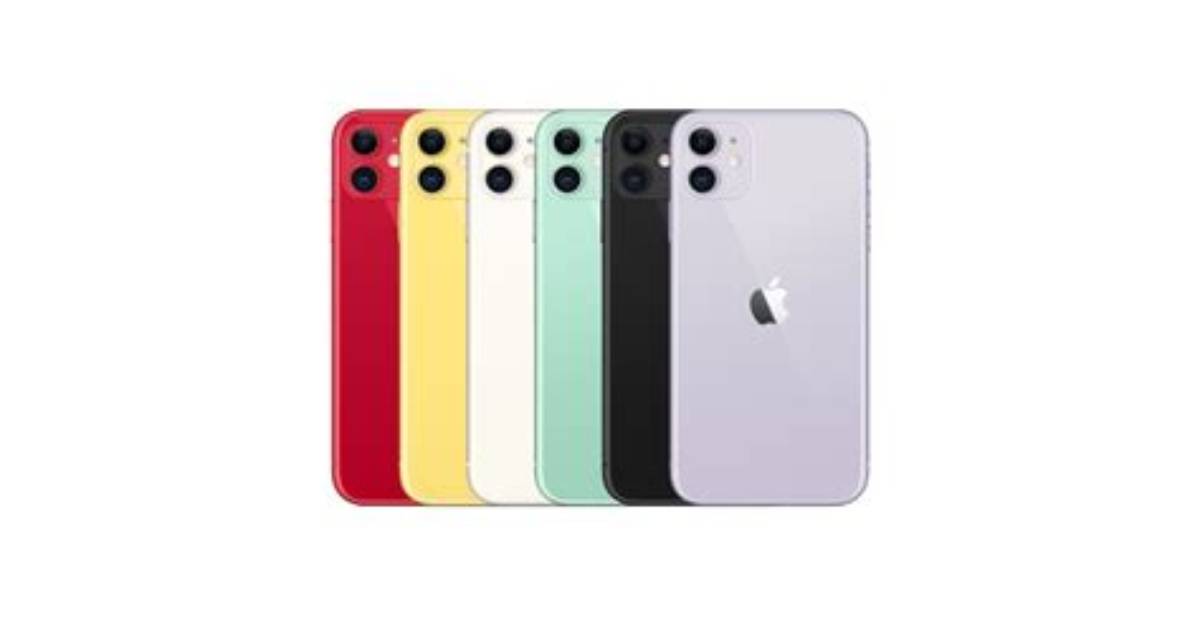
Discover the impressive hardware properties of the iPhone 11.
Design
In terms of design, this phone does not bring many surprises, as it is quite similar to the 2018 iPhones. It is made of ion-strengthened glass on the front and back. Its frame is made of brushed aluminium instead of the stainless steel that is featured on the more premium 11 Pro models.
It comes in a set of new colours, namely Product Red, Purple, Black, Yellow, White, and Green. Unlike the Pro versions that have a frosted finish, this phone has a glossy back, which makes it more susceptible to smudging. It is also not as scratch resistant as the other finishes.
The size is pretty much comfortable in the hand, considering that it is larger than the 11 Pro. Interesting to note is that the dimensions and weight are the same as its predecessor, the XR.
Display
The screen of this handset is the same as the XR’s. It is a 6.1-inch IPS LCD with a sizable notch cut-out and a pixel density of 326 PPI. The bezels on this phone are thicker than on the more advanced models with OLED screens. These bezels do stand out at first, but you will get used to it.
Its screen is excellent with accurate colours and good contrast. The True Tone feature automatically adjusts white balance based on ambient light. Although the panel is not as sharp as in the Pro models, it is difficult for one to tell the difference using the naked eye.
On the left side of the device, you will find a standard ring/silent switch and the volume keys. On the right side, there is a power button and a SIM tray. This model supports dual SIM, Nano-SIM and e-SIM. It is important to note that the iPhone 11 is not compatible with existing micro-SIM cards.
It is packed with a lightning charging port and loudspeaker at the bottom, and dual cameras at the back, alongside the iPhone logo, which is positioned almost at the middle part of the back. The bezels on the 11 are similar to those in the XR.
The iPhone 11 does not offer Dolby Vision or HDR support, which are available on the higher tier models. Maximum brightness is good, and users should not experience any problem using it outdoors.
Processor, storage, and performance
Inside this device is the new A13 Bionic chipset, and along with that is 4GB of RAM as the iPhone 11 memory capacity. This chipset is more efficient than the one used in its predecessors. The ROM for this handset comes in three capacities, 64 GB, 128GB, and 256GB.
The performance of this handset is the same as on the Pro versions. It is incomparable to anything in the Android world. It provides 20% better CPU performance over 2018’s chipset. It also does a great job of staying cool, thanks to heat dispersing graphene layers. Therefore, the performance for something like heavy gaming is great as it does not experience thermal throttling.
It is important to keep in mind that the storage is not expandable. Therefore, if you choose to buy the 64GB option, you might run out of space quite fast if you are fond of taking pictures, videos, screenshots, and downloading games.
iPhone 11 battery capacity
It has a 3100mAh battery, just slightly bigger than the XR’s. Its battery life is even much better than the Pro’s, probably as a result of the different power drawn from the screens. This phone comes with a 5W charger, which charges from 0% to 18% in 30 minutes. Luckily, you can purchase an 18W iPhone charger, which will get you up to 55% within the same duration.
There is support for Qi wireless charging in case you do not want to use a wired charger. Apple does not make charging pads, so you will have to use a third-party one.
Speaker and call quality
This handset comes with a pair of stereo loudspeakers. They are not as balanced as those on the Pro models, which produce more bass from the top speaker. However, they still have a rich sound with very good measured loudness and support for spatial audio. Call quality is also top-notch.

