How does the Expected Value Calculator work?
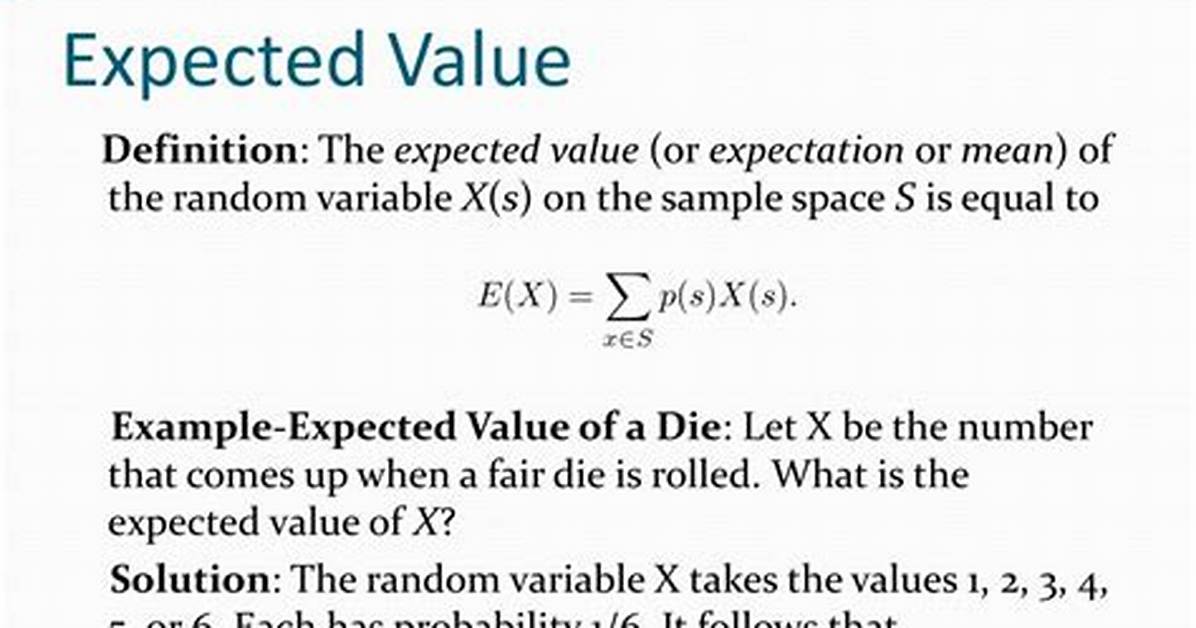
Free Expected Value Calculator - This lesson walks you through what expected value is, expected value notation, the expected value of a discrete random variable, the expected value of a continuous random variable, and expected value properties.
What 7 formulas are used for the Expected Value Calculator?
E(aX) = aE(x)
E(X + Y) = E(X) + E(Y)
E(c) = c
When X and Y are independent random variables, we have E(X Y) = E(X) · E(Y)
σ2 = Var(X) = E(X - μ)2
Discrete Random Variable: E(X) = Σxi · P(x)
Continuous Random Variable: E(X) = -∞∫∞x · P(x)dx
E(X + Y) = E(X) + E(Y)
E(c) = c
When X and Y are independent random variables, we have E(X Y) = E(X) · E(Y)
σ2 = Var(X) = E(X - μ)2
Discrete Random Variable: E(X) = Σxi · P(x)
Continuous Random Variable: E(X) = -∞∫∞x · P(x)dx
For more math formulas, check out our Formula Dossier
What 6 concepts are covered in the Expected Value Calculator?
- constant
- a value that always assumes the same value independent of how its parameters are varied
- continuous random variable
- one which takes an infinite number of possible values
- discrete random variable
- a type of variable whose value depends upon the numerical outcomes of a certain random phenomenon
- expected value
- predicted value of a variable or event
E(X) = ΣxI · P(x) - product
- The answer when two or more values are multiplied together
- statistics
- Statistics is a discipline concerned with the analysis of data and decision making based upon data.

